
What actually happens during a detailing appointment, start to finish
Most people book a detail without ever having watched one happen. Here is what the day actually looks like, in order.
September 25, 2026 · 4 min read · Practical
Before we ever arrive
The appointment starts with the message you send us: the vehicle or furniture, its condition, a few photos if you have them, and where the job will happen. We come back with a real scope and a real price based on what you told us, not a placeholder number that changes once we see the vehicle in person.
We confirm water and power access at that point too, since that is the one thing that decides whether the appointment can happen at all. Nobody should find that out on the morning of the visit.
Setting up on arrival
Setup takes a few minutes, not a production. Vacuums, the extraction machine, brushes, buckets and product all come out of the vehicle and get arranged near the spigot and outlet you pointed out when you booked. A standard driveway is comfortable working space, and your driveway stays usable around us rather than blocked entirely.
What you will hear and smell
A wet-vacuum and an extraction machine both run at a normal vacuum-cleaner volume, not something disruptive, though they do run for a good portion of the appointment rather than in short bursts. Most cleaning products we use are mild enough that you would need to be standing right next to the vehicle to notice a scent, and nothing lingers strongly once a window or door has been open for a few minutes.
If you are working from home during the appointment, none of this typically requires stepping away from a call or a desk near the driveway. It is closer to the sound of a neighbor mowing a lawn than anything more disruptive.
If interior work is on the schedule
We start dry, before any liquid touches the cabin. Mats come out, seats go all the way forward and back, and a crevice tool works into the seat rails, seams and map pockets that a normal vacuum never reaches. Compressed air clears grit out of vents and switch gear next.
Then the wet stage: carpets and cloth seats get pre-treated, agitated, and extracted with heated solution that goes in and comes back out through the same head. Steam handles hard trim, cup holders and jambs. Leather gets its own pH-appropriate cleaner, a soft brush, and conditioner, never the extractor.
If exterior work is on the schedule
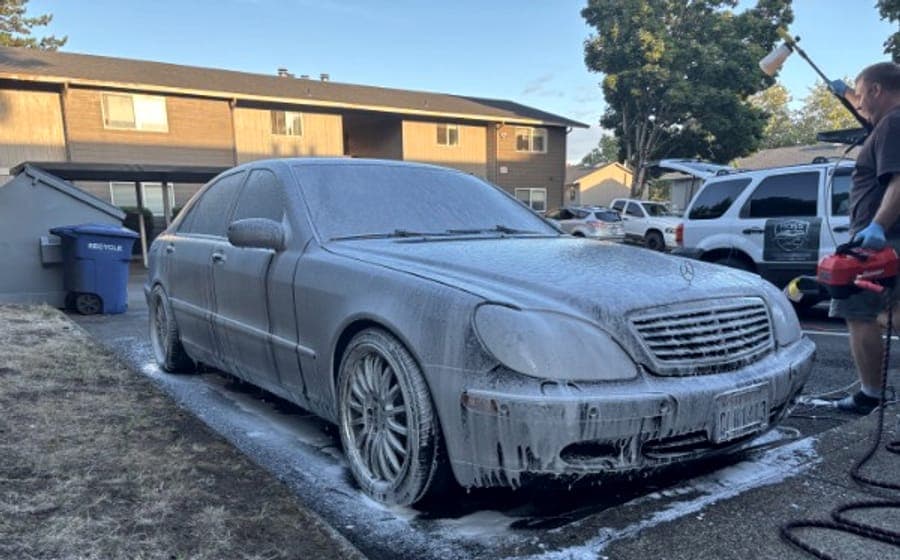
Wheels and tires come first, while the paint is still cold. Faces, barrels and lug seats get cleaned by hand and the wells get flushed, all before the car gets its wash. The paint itself gets a foam pre-soak and dwell time to lift loose contamination, then a two-bucket hand wash with fresh media per section, so nothing gets dragged from a dirty lower panel up onto a cleaner one.
If both interior and exterior are booked, we typically run them in parallel rather than back to back, since one of us can be inside the cabin while the other is on the paint, which is part of why booking both together saves real time, not just money.
If furniture is on the schedule instead
Indoor pieces get cleaned in place, so nothing has to be carried outside. Fabric is pre-treated, agitated and extracted, leather gets cleaner and conditioner. Outdoor furniture gets the same extraction principle applied with extra attention to drying, since a cushion put back into use still damp just restarts whatever problem it had.
The walkaround before we leave
We go over the finished work with you rather than just handing back the keys. That includes pointing out anything that is still slightly damp and expected to be, like a freshly conditioned leather seat or a wheel well that has not fully dried, so it does not look like an unfinished job when it is actually a normal part of the process.
If something did not fully come out, a stain that lightened rather than disappeared, for instance, we say so directly and explain why, rather than letting you discover it later and wonder if it was missed.
What to check before we leave
A short check on your end at handover catches anything worth flagging while we are still there to address it.
- Any pre-existing damage or wear was pointed out before work started, not discovered as a surprise afterward
- Any stain or spot that did not fully lift was explained, including why
- Mirrors, seat position and any settings that had to be adjusted for access are back where you want them
- Anything moved from the trunk, cargo area or a piece of furniture is exactly where you left it
What a first-time booking looks like versus a repeat one
The first appointment at a new address takes a little longer at the start, since we are confirming the water and power setup and getting a feel for the space for the first time. A repeat visit at the same address moves faster from the first minute, since setup is already familiar and we know what the vehicle or space typically needs. Neither is a different service. It is simply the same efficiency that comes with familiarity anywhere.
What happens if something needs more than expected
Occasionally a job reveals something the initial photos did not fully show, a stain that goes deeper than it looked, or an odor source that takes longer to track down. When that happens we stop and tell you what we found and what it would take to address it, rather than either quietly running long unannounced or rushing to finish within the original estimate at the expense of the result.
This is the same reason we quote from photos before every visit. It keeps surprises rare, and on the rare occasion one still turns up, you hear about it as a straight conversation, not a bigger number on the invoice you were not expecting.
Realistic timing
An exterior wash generally runs one to three hours depending on size and condition. A full interior detail runs two to six hours for the same reasons. Furniture depends entirely on how many pieces and their condition, which is why that gets a real estimate after photos rather than a flat number up front. We would rather quote a longer window and finish early than the other way around.